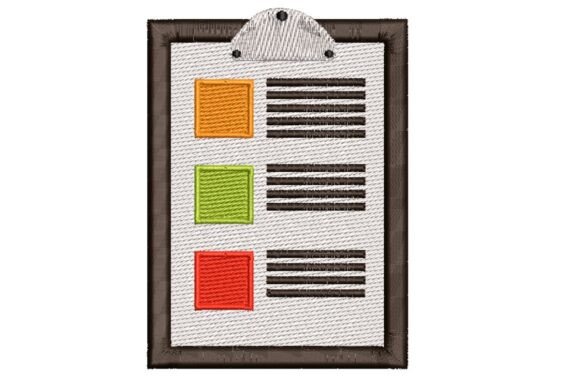
Paper with Graph and Formulas: STEM Embroidery Review
As an embroidery designer preparing for a weekend craft fair, I constantly evaluate which digital assets will translate into tangible sales. When reviewing the Paper with Graph and Formulas machine embroidery design, my immediate assessment focuses on its niche appeal within the School category. This is not a generic floral or seasonal motif; it is a specialized illustration featuring data paper, numerical entries, and mathematical formulas. For Etsy sellers and boutique makers targeting academics, students, and STEM professionals, this design offers a distinct advantage. It moves beyond standard school supplies into the realm of intellectual aesthetic, making it a strong contender for specific handmade products.
First Impressions: Academic Precision Meets Thread Art
The visual mood of Paper with Graph and Formulas is decidedly modern, intellectual, and structured. Unlike rustic farmhouse designs or soft nursery motifs, this embroidery file communicates precision. The presence of graph lines and formulaic text suggests a clean, minimalist aesthetic that appeals to adults in academia rather than young children. As a craft fair product, this design signals "premium" and "specialized." It does not scream for attention with bright primary colors but rather invites closer inspection through intricate detail. For a booth display, this means the design serves as an excellent conversation starter for a specific demographic. Customers who identify as engineers, mathematicians, or science teachers will recognize their own professional language stitched into fabric, creating an instant emotional connection that generic designs cannot replicate.
Best Product Applications for STEM Markets
Evaluating where this design performs best requires understanding the end-user's daily life. Based on the description highlighting study decoration and STEM fields, certain products naturally outperform others:
- Tote Bag Design: This is likely your highest conversion item. Academics and students carry books, laptops, and research materials constantly. A canvas tote featuring Paper with Graph and Formulas acts as a professional identifier. Ensure the design is centered and sized appropriately for a 15oz cotton canvas to maintain readability from a distance.
- Tea Towel Embroidery: While kitchen towels are often associated with food, "study snacks" and coffee culture are huge in academia. A high-quality linen tea towel with this design makes an exceptional gift for graduate students or professors. The flat weave of tea towels also supports the fine lines of graph paper better than terry cloth.
- Embroidered Patch: For lab coats, backpacks, or pencil cases, converting this design into a patch format increases versatility. Patches allow customers to customize items you do not sell directly. This expands your inventory reach without increasing physical stock.
- Apron Embroidery: Target science teachers or lab technicians. A sturdy denim or twill apron with this mathematical motif elevates a functional garment into a personalized uniform. It distinguishes the wearer in a classroom or laboratory setting.
- Fabric Pouches and Pillow Covers: These serve as decorative study accents. As mentioned in the product description, these are ideal for decorating study spaces. Small zippered pouches for pens, calculators, or USB drives are practical small shop products that utilize smaller hoop sizes efficiently.
Production Realities: Stitch Density and Fabric Texture
From a technical production standpoint, Paper with Graph and Formulas presents unique challenges that must be addressed before batch production. Graph paper implies straight, continuous lines, while formulas require legible text. These two elements behave differently under the needle.
Stitch density is the primary concern. If the graph lines are too dense, they can perforate lightweight fabrics or cause puckering on tote bags. Conversely, if the mathematical symbols are too sparse, they may lack definition. You must verify the digitizing quality specifically for the intended fabric weight. For textured towels or thick canvas, running stitches used for graph lines may get lost in the fabric weave. In these cases, a satin stitch border or increased underlay might be necessary to lift the design above the texture.
Small lettering in formulas is another critical failure point. If the design includes complex equations, test the minimum readable size. Text below 4mm in height often becomes illegible after washing. As a commercial embroidery business owner, I recommend stitching a test sample on your exact selling substrate. Do not assume a digital preview equates to a successful finished product. Check thread colors against dark fabrics; white or cream thread on navy canvas provides the classic "blueprint" look, whereas low-contrast combinations will render the formulas invisible at a craft fair table.
Merchandising and Visual Appeal at Craft Fairs
Visual appeal for this design relies heavily on contrast and context. At a market booth, Paper with Graph and Formulas should be displayed alongside relevant props to signal its niche immediately. Placing a vintage calculator, a stack of textbooks, or reading glasses next to the embroidered tote bag helps customers instantly categorize the item. Without context, passersby might mistake the graph lines for abstract art or plaid.
For online sales, printable mockups are useful for listing creation, but real photography sells handmade quality. Photograph the embroidery at an angle that shows the sheen of the thread and the texture of the stabilizer backing. Buyers need to see that the graph lines are straight and the formulas are crisp. Highlight the "handmade product" aspect by showing the back of the hoop or the finishing details of a pouch. This builds trust that the item is professionally constructed, not just a printed image.
When pricing, factor in the perceived value of specialization. Niche designs like this often command higher prices than generic motifs because they are harder to find. Emphasize the relevance to STEM fields in your product tags and descriptions. Use terms like "math teacher gift," "science student decor," and "academic aesthetic" to capture search traffic.
Essential Designer Checklist Before Selling
Before listing Paper with Graph and Formulas as a commercial embroidery offering, complete this verification process:
- Verify Licensing: Confirm the digital embroidery file includes commercial rights for finished products. Some files are restricted to personal use only.
- Test Stabilizer Pairings: Graph lines require stability. Use a cut-away stabilizer for stretchy fabrics or tote bags to prevent distortion. Tear-away may suffice for crisp tea towels but risks shifting during long runs of linear stitching.
- Audit Hoop Size Compatibility: Ensure the design fits your available hoops without excessive re-hooping. Large graph designs may exceed standard 4x4 limits. Check the exact dimensions in the file metadata.
- Assess Thread Contrast: Stitch out the design on your darkest and lightest selling fabrics. Adjust thread colors if the formulas disappear. High contrast is non-negotiable for data visualization themes.
- Create Physical Samples: Never rely solely on software simulations. Produce at least one saleable sample to photograph and display. This confirms the design’s durability and aesthetic appeal in real-world conditions.
- Review Spacing and Alignment: Mathematical formulas must be perfectly aligned to look authentic. Even slight registration errors can make equations look incorrect, undermining the "precision" vibe of the design.
Paper with Graph and Formulas represents a valuable asset for embroidery businesses targeting the education and science sectors. Its success depends entirely on execution. By respecting the technical demands of stitching graphs and text, and by merchandising the finished product to its specific audience, you can transform this digital file into a profitable, repeatable seller for your handmade business. Always prioritize clarity and fabric compatibility over speed, ensuring every stitch honors the academic precision the design promises.