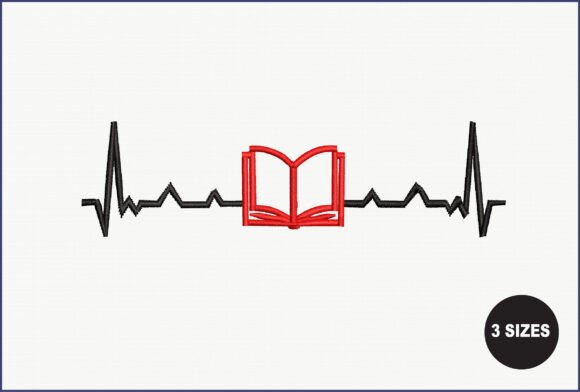
Book Heartbeat Line: A Designer’s Stitch Review
When evaluating a new machine embroidery design for my shop, I look past the digital preview and imagine the needle hitting fabric. The Book Heartbeat Line immediately caught my attention as a potential staple for the upcoming back-to-school season and year-round literary gifts. As a minimalist concept featuring an open book integrated into an EKG rhythm, it promises versatility. However, minimalism in embroidery is often harder to execute than complex designs because there is nowhere to hide tension issues or poor digitizing. After reviewing this design with a critical eye toward real-world application, here is my professional assessment for fellow makers, Etsy sellers, and apparel decorators.
First Impressions and Visual Balance
The visual mood of the Book Heartbeat Line is clean, intellectual, and subtly emotional. It avoids the cluttered aesthetic that plagues many teacher-themed designs, opting instead for a modern line-art approach. For a craft business targeting librarians, English teachers, or avid readers, this restraint is a selling point. It feels like a boutique logo rather than a generic clip-art transfer. The transition from the heartbeat line into the open book appears balanced, but as a reviewer, I am immediately checking the anchor points. In minimalist designs, the connection between the running stitch line and the central motif must be seamless. If the digitizer has not properly tied off or overlapped these sections, you risk unraveling after a few washes. Visually, it reads well at both chest-size and pocket-size dimensions, making it a strong candidate for varied custom apparel.
Real-World Application: The Library Tote Test
To truly judge this embroidery file, I mentally placed it on a canvas tote bag intended for a local library fundraiser. Totes are high-stress items; they get washed, stuffed with heavy books, and folded repeatedly. This scenario tests the structural integrity of the design. The Book Heartbeat Line works exceptionally well here because the horizontal orientation mimics the natural shape of a bag panel. Unlike tall, vertical designs that can distort when a bag is loaded, this linear layout maintains its proportion.
For this specific handmade product, I would avoid using a heavy fill stitch for the book element. Instead, verifying that the design utilizes a combination of running stitch for the pulse line and perhaps a light satin or detailed outline for the pages keeps the fabric from puckering. Canvas has a distinct fabric texture, and dense stitching can cause tunneling. If the file allows, using a slightly heavier thread weight (like 30wt) for the heartbeat line could add necessary tactile presence against the coarse canvas, elevating the perceived value of the finished tote.
Fabric Compatibility and Stabilizer Strategy
While the design shines on stable woven fabrics, caution is required for stretchy knits. I frequently see sweatshirt embroidery fail with line art because the fabric shifts during stitching, resulting in wavy lines that should be straight. If you are applying the Book Heartbeat Line to a hoodie or t-shirt, your stabilizer choice is non-negotiable. A cut-away stabilizer is essential to support the continuous line work. Tear-away options simply cannot handle the lateral pull of a long heartbeat trace on jersey knit.
Furthermore, consider the hoop size relative to the design dimensions. Even if the design fits within a 4x4 hoop, using a larger hoop with proper floating techniques can sometimes yield better registration for linear designs, reducing re-hooping errors. Always check the specific dimensions provided with the digital embroidery file before purchasing. Assuming standard sizing can lead to disappointment if the aspect ratio doesn't match your intended placement area on a cap or sleeve.
Navigating Detail and Contrast Challenges
Minimalist designs rely entirely on contrast. When testing the Book Heartbeat Line, I recommend stitching out samples on both white and navy fabrics. On dark fabrics, a single strand of white thread might disappear visually, making the heartbeat look broken. You may need to increase stitch density or use two passes of thread to ensure the line pops against dark backgrounds. Conversely, on very light fabrics, ensure the underlay isn't so dense that it shows through the top stitches, creating a shadow effect that muddies the crisp lines.
Be mindful of small details within the open book motif. If the pages are defined by tiny satin columns less than 1mm wide, they may be difficult to produce consistently on older machines or with thicker threads. For baby embroidery or items requiring frequent laundering, verify that these fine elements are robust enough to withstand wear. If the details are too delicate, consider simplifying the book element or scaling up the design to maintain clarity and durability in the finished product.
Commercial Viability for Sellers and Makers
For Etsy sellers and small shop owners, the Book Heartbeat Line offers excellent merchandising potential due to its broad demographic appeal. It bridges the gap between academic professionalism and personal passion. However, before listing any personalized gift or commercial item, strictly review the licensing terms associated with the design assets. Confirm whether the license covers physical products only or extends to digital previews and printable mockups used in marketing.
From a branding perspective, this design supports consistency. Its simple geometry allows it to pair easily with custom text, school mascots, or library names without competing for attention. When creating listings, photograph the actual stitched sample rather than relying solely on digital renders. Customers trust seeing the thread colors and texture in natural light. Showcasing the design on multiple substrates—perhaps a mug cozy alongside a teacher appreciation card—demonstrates versatility and justifies premium pricing for your commercial embroidery services.
Essential Pre-Stitch Checklist
Before committing this design to a final project, run through this practical checklist to ensure professional results:
- Test Stitch First: Never run a new embroidery project on a final garment without a test run on similar scrap fabric to check tension and registration.
- Verify File Integrity: Open the embroidery file in your software to confirm stitch count and color changes match the product description.
- Check Thread Contrast: Evaluate visibility on your chosen fabric; adjust density or thread weight if the line lacks definition.
- Stabilizer Match: Select cut-away for knits and tear-away or wash-away for stable wovens based on the design's density.
- Mockup Validation: Create black and white mockups to assess value contrast independent of color bias.
- Licensing Confirmation: Document your right to sell finished goods or use the design in small shop product marketing.
- Wash Testing: For items like tea towels or baby clothes, wash the test sample to ensure the minimalist lines do not distort or fray.
The Book Heartbeat Line is a sophisticated addition to any embroiderer's library, provided it is treated with the technical respect that line art demands. By focusing on proper stabilization, appropriate fabric pairing, and rigorous testing, you can transform this digital concept into a cherished, high-quality embroidered piece that resonates deeply with readers and educators alike.